Essential Hiking Gear Before You Go
By Asheville Hikes ·
Essential Hiking Gear: What to Carry on Every Day Hike Near Asheville
Oct 5, 2026 · @David
By David. David runs Asheville Hikes and is an avid AVL hiker with over 5 years of experience hiking in the area. Published October 20, 2026. Last updated October 20, 2026.
Day hikers make up far more of the rescues than backpackers do, and most carry too little. Pack a satellite communicator, first aid kit, map and compass, headlamp, emergency blanket, rain jacket, whistle, and backup battery every time, even for a two-hour loop.
Key takeaways Day hikers made up 42 percent of national park search and rescue cases from 2004 to 2014, against 13 percent for overnight backpackers, according to National Geographic. Only 15.7 percent of day hikers in a 2024 Rocky Mountain National Park survey met the study's standard for wilderness preparedness, per a 2026 paper in Wilderness & Environmental Medicine. Cell service can vanish in the mountains, so sort out a satellite communicator or your phone's satellite SOS first. Practice the satellite SOS on your phone before you need it. iPhone 14 and later and Pixel 9 and later (except the 9a) both have a demo mode. The rest of the kit is small: first aid, splint, emergency blanket, rain jacket, map and compass, headlamp, battery, and whistle. What counts as essential hiking gear?
The standard answer is the Ten Essentials, a list of survival systems that The Mountaineers started in the 1930s and that REI still updates. REI's version groups them by job: navigation, headlamp, sun protection, first aid, knife and repair kit, fire, shelter, extra food, extra water, and extra clothes.
REI says you can trim the list when help is close and should build it out when rescue could take hours or days. Plenty of trails around Asheville sit well past quick help, so I skip the trimmed version.
Pack water, food, sun protection, and a fire starter on every hike. This post covers the rest of that list, plus the extras I'd add for Western North Carolina: satellite SOS, a splint, a whistle, backup power, bathroom gear, and a dog sling if your dog hikes with you.
Are day hikes more dangerous than backpacking trips?
Day hikes are often the more dangerous trip, and the gap comes down to preparation, not terrain. Across national parks from 2004 to 2014, day hikers made up 42 percent of 46,609 search and rescue cases, almost four times the 13 percent for overnight backpackers, National Geographic reported.
One fair caveat: share of rescues is not risk per hiker. Day hikers are also the biggest crowd on the trail, and rescue counts can't separate those two things. Preparedness data can.
In a 2024 survey of 654 hikers and trail runners at Rocky Mountain National Park (586 day hikers and 68 trail runners), only 15.7 percent of day hikers and 25 percent of trail runners were wilderness prepared, according to News-Medical and On Scouting. The study counted you as prepared if you carried at least one liter of water, seven emergency items from the Ten Essentials, a map or equivalent, and either two rescue devices or eight of 15 recommended first aid items. The paper ran in Wilderness & Environmental Medicine in March 2026.
The older numbers point the same way. In 2012, day hikers were involved in 1,817 of the National Park Service's 2,876 search and rescue missions, or 43.3 percent, National Parks Traveler reported.
Closer to home, Andrew Herrington, a survival instructor and search and rescue team leader in Great Smoky Mountains National Park, estimated that about 90 percent of the park's roughly 100 yearly rescue incidents involve day hikers, he told National Geographic.
Why the gap? National Geographic's reporting points to mindset. Backpackers pack survival gear by default. Day hikers tend to leave with water, a snack, and a camera. A short trail feels like a walk until a rolled ankle, a missed turn, or fading light turns it into a night out. The research National Geographic cites ranks wandering off trail as the top reason adult hikers need rescue, ahead of injury and bad weather.
Tell someone your route and your turnaround time before you go. Lambert, the Rocky Mountain study's author, says rescuers alerted an hour or two after you are overdue, instead of a day later, can make the difference between life and death.
While I fortunately haven't needed my emergency gear while on a hike (yet), I did test out the iPhone's Satellite Texting feature while on a hike 2 weeks before Hurricane Helene hit us, and that experience certainly came in handy when our entire community had power, cell signal or internet for 4 days!
How do I call for help when there is no cell service?
Carry a satellite communicator, and learn the satellite SOS built into your phone as a backup. A Garmin inReach Mini 3 Plus sends an SOS to a coordination center staffed around the clock from anywhere with a view of the sky, and it needs an active subscription.
My pick: Garmin inReach Mini 3 Plus
The Mini 3 Plus is Garmin's smallest satellite communicator with a color touchscreen, a built-in speaker and microphone, and photo and voice messaging. It sends texts, check-ins, and SOS messages over the Iridium satellite network, and it pairs with your phone for a full keyboard and map navigation. At launch the Mini 3 Plus listed for $499 and the standard Mini 3 for $449, according to Bikepacking.com. If you only want SOS and texting, the standard Mini 3 does that for less. Both models need a satellite subscription. Plans are month to month.
Subscription cost: Garmin lists its consumer plans here.
Where to buy: Garmin or REI.
Learn your phone's satellite SOS before you need it
An iPhone 14 or later can text emergency services by satellite when you have no cellular or Wi-Fi, Apple says, and Apple includes the feature free for two years after you activate the phone. To practice, open Control Center, tap the Cellular button, tap Satellite, then tap Try Demo. The demo does not call emergency services.
Expect it to be slow. Apple says a message can take 30 seconds or more with a clear view of the sky, and up to several minutes under light or medium foliage. Heavy foliage can block the connection. That matters on Asheville trails, so practice in the open and hold the phone in your hand, not in a pocket or pack.
Pixel phones since the Pixel 9, except the Pixel 9a, have Satellite SOS. With no signal, dial 911, tap Satellite SOS, then tap Use Satellite SOS and Start. The demo lives under Settings, Safety & emergency, Satellite SOS. [STAT NEEDED: confirm whether recent Samsung Galaxy phones support satellite SOS. I only verified Pixel and iPhone.]
Whistle: Fox 40 Classic
A whistle has no battery to die. The Fox 40 Classic has no pea to jam or freeze, gets louder the harder you blow, and REI lists it at up to 115 decibels, loud enough to signal rescuers from up to a mile away by REI's description. Three blasts is the standard distress signal.
What should I carry for injuries and bad weather?
Carry a first aid kit, a moldable splint, an emergency blanket, and a rain jacket. In an analysis of more than 1,000 Rocky Mountain National Park rescues, falls, injuries, and illness were among the leading causes, according to On Scouting. A hiker with a sprained ankle who is also wet and cold gets into trouble fast.
First aid kit: Adventure Medical Kits Ultralight/Watertight .7
REI lists this kit at 5.8 ounces, with two layers of waterproofing and supplies for up to three people for up to three days. It holds bandages, medications, tape, and moleskin for blisters, plus supplies to immobilize fractures and close wounds. Add whatever only you need, like personal medications, and check expiration dates twice a year. A kit is only as good as the person opening it, so take a wilderness first aid course.
Where to buy: REI.
Splint: SAM Splint, 36-inch roll
A SAM Splint is an aluminum core between two layers of closed-cell foam. It bends into a curve that makes it rigid, it is waterproof and reusable, and SAM Medical offers the 36-inch size in a roll. It cuts to size with ordinary scissors. A splint steadies an injury so you can get out or wait for help, and it does not replace a rescue. Practice molding it on a friend's arm at home, not for the first time on a ridge.
Where to buy: SAM Medical. Pricing varies by size.
Emergency blanket: SOL Emergency Bivvy
A foil blanket works, but a bivvy keeps the wind off you. The SOL Emergency Bivvy weighs 3.8 ounces, measures 84 by 36 inches, reflects 90 percent of your body heat, and has waterproof, windproof, seam-taped fabric that REI says is quiet and tear resistant. Climb inside like a sleeping bag or turn it inside out and wrap up like a blanket. Bass Pro Shops lists a stuff sack, whistle, and a paracord drawstring that doubles as fire tinder.
Where to buy: Amazon.
Rain jacket: REI Co-op Rainier
The Rainier uses 2.5-layer recycled ripstop nylon, has pit zips and a drawcord hem, and stows in its own pocket, REI says. REI rates it to block wind up to 60 miles per hour. A rain jacket is also your wind layer and your emergency layer, so carry it when the forecast is clear. Mountain weather changes its mind.
Where to buy: REI Co-op rain jackets. [LINK NEEDED: the Rainier product page.]
How do I find my way and keep the lights on?
Carry a paper map and a baseplate compass that need no battery, plus a headlamp and a power bank for everything that does. Phones freeze, crack, and run dry. Paper and a needle keep working.
Map: National Geographic Trails Illustrated, Pisgah Ranger District (Map 780)
This waterproof, tear-resistant map shows contour lines and elevations, with the Art Loeb, Mountains-to-Sea, and Palmetto trails marked, and it covers the Shining Rock and Middle Prong wildernesses, according to Public Lands' listing. Buy the current edition. REI reviewers of older Pisgah printings complained about missing and misdrawn trails. For trailheads outside the Pisgah Ranger District, pick the sheet that covers yours.
Where to buy: Amazon. Check that the listing is Map 780 and the current edition.
Compass: Suunto A-30
The A-30 has a steel needle on a jewel bearing, luminescent markings for low light, a magnifying lens on the baseplate, and a declination correction scale, according to Suunto. Buy the northern hemisphere version. A compass only helps if you know how to use it, so practice with your map in a park before you need it on a trail.
Where to buy: Suunto.
Headlamp: Fenix HM65R Rechargeable LED Headlamp (I love this headlamp for it's comfort, brightness, toughness and rechargeability with USB-C!)
The Fenix HM65R rechargeable headlamp is crafted from ultra-lightweight magnesium and engineered to withstand nature's elements. With two Cree LEDs, the HM65R delivers 1400 Lumens and offers dual spotlight and floodlight mode. It is powered by a single 18650 battery (included), or alternatively, two CR123A batteries (not included). This headlamp also features USB Type-C Charging for the included 18650 battery. Additionally, the HM65R boasts IP68 waterproofing, IP6X dust-proofing, and 2 meters of impact resistance. An adjustable headband allows for a secure and comfortable fit in any situation.
Where to buy: www.fenix-store.com.
Backup battery and cables: Anker Zolo 10,000 mAh
REI lists the Anker Zolo 10,000 mAh power bank with a built-in USB-C cable at 8.1 ounces. Charge it before every hike and keep it in an inner pocket on cold days, since cold drains batteries. Pack a short spare cable that matches every device you might need to charge, including your phone and your communicator.
Where to buy: Amazon or REI power banks.
Do I need a rope and a knife on a day hike?
Carry 30 feet of 550 paracord and a small folding knife. Neither is climbing gear. Both fix small problems before they become big ones, like lashing a splint, rigging a shelter, or cutting tape and moleskin.
Rope: 550 paracord
REI sells Gear Aid Heavy-Duty 550 Paracord in 30-foot and 100-foot lengths. Thirty feet is plenty for a day pack. Paracord is utility cord, not a lifeline. Nite Ize, a paracord maker, warns that its cord is not designed to hold your body weight or lift heavy objects overhead, so never use it to climb, rappel, or lower anyone.
Where to buy: REI. REI lists it at 4 mm by 30 feet and 550 pounds of strength, and says it is not intended for climbing.
Knife: Victorinox Classic SD
The Classic SD has seven tools, including a small blade, scissors, and tweezers, and it weighs about 0.7 ounces at 2.3 inches closed. The blade does not lock. I'd rather carry a small knife I forget about than a big blade I leave in the truck, and the scissors and tweezers do more first aid work than a big blade would.
Where to buy: Amazon.
How do I go to the bathroom on the trail without leaving a trace?
Pack a trowel, a pee cloth or toilet paper in a sealed bag, hand sanitizer, and a waste bag kit for emergencies. For solid waste, walk 200 feet from water, trails, and campsites, dig a hole 6 to 8 inches deep, then cover and disguise it. The USDA Forest Service calls waste bags the best option for solid waste and catholes the next best.
Nature calls. It does not provide a restroom.
How to dig a cathole Walk at least 200 feet, about 70 steps, from water, trails, parking areas, and campsites. Pick a sunny spot with rich soil and no roots or large rocks. Sun and soil help waste break down faster. Dig a hole 4 to 6 inches wide and 6 to 8 inches deep, per the Forest Service and Leave No Trace. Do your business. Keep the trowel away from your waste. It only digs and covers. Fill the hole with the original dirt and cover it with natural material like leaves and sticks. Pack out used toilet paper and wipes in a double zip bag. The Forest Service says biodegradable toilet paper can go in the hole. Clean your hands. Use soap and water if you have it. If not, use a sanitizer with at least 60 percent alcohol, the CDC says, and wash with soap and water when you can, because sanitizer works poorly on visibly dirty or greasy hands.
For urine, keep the same 200 feet from water, and pack out or bury your toilet paper, per the Forest Service. On winter hikes, the Appalachian Mountain Club recommends packing out all solid waste, because cold slows decomposition.
Trowel: TheTentLab DirtSaw Deuce #2
The DirtSaw Deuce #2 weighs 0.6 ounces, and REI lists it with teeth for cutting through dirt. Know the tradeoff. REI reviewers rate it 3.3 out of 5 across 14 reviews, and several say it struggles with roots. A cheap plastic trowel is heavier and works fine in soft soil.
Pee cloth: Kula Cloth
The Kula Cloth has a waterproof side to keep your hand clean and an antimicrobial absorbent side for wiping. It weighs 0.4 ounces, snaps to your pack, and cuts down on toilet paper you would otherwise carry out. REI reviewers rate it 4.6 out of 5 across 228 reviews.
Emergency waste bag: Cleanwaste GO Anywhere (WAG Bag)
Each Cleanwaste GO Anywhere kit has a waste bag with a gelling powder, a zip-close disposal bag, toilet paper, and a hand wipe. Do not bury the bag. Seal it and carry it out. REI says sealed kits can typically go in regular trash, but check local guidelines.
Hand sanitizer
No brand pick here. Check the label for at least 60 percent alcohol and go with the smallest bottle that fits your pocket.
What should I carry when I hike with my dog?
Carry a rescue sling sized to your dog, and practice with it at home. If your dog gets hurt or can't walk, a sling lets you carry them out, even if you are hiking alone. Carry water for your dog as well.
My pick: Non-stop Dogwear Dog Rescue Sling
The sling has four leg openings that spread your dog's weight and straps that let you carry them in front, at your side, or on your back. Non-stop Dogwear says it developed the sling with the Norwegian Search and Rescue Dog Association. It comes in sizes S to XL by dog weight and packs small. If you are alone, Non-stop recommends a front carry so you can watch your dog as you walk. It also recommends practicing at home several times, so your dog gets used to being lifted and you get faster.
Be honest about your dog's weight and your own back. A sling gets a small or medium dog out. With a big dog, it may only get you to a safer spot before you call for help.
Where to buy: Non-stop Dogwear. [VERIFY: sizes were showing sold out on the US shop page when I checked.]
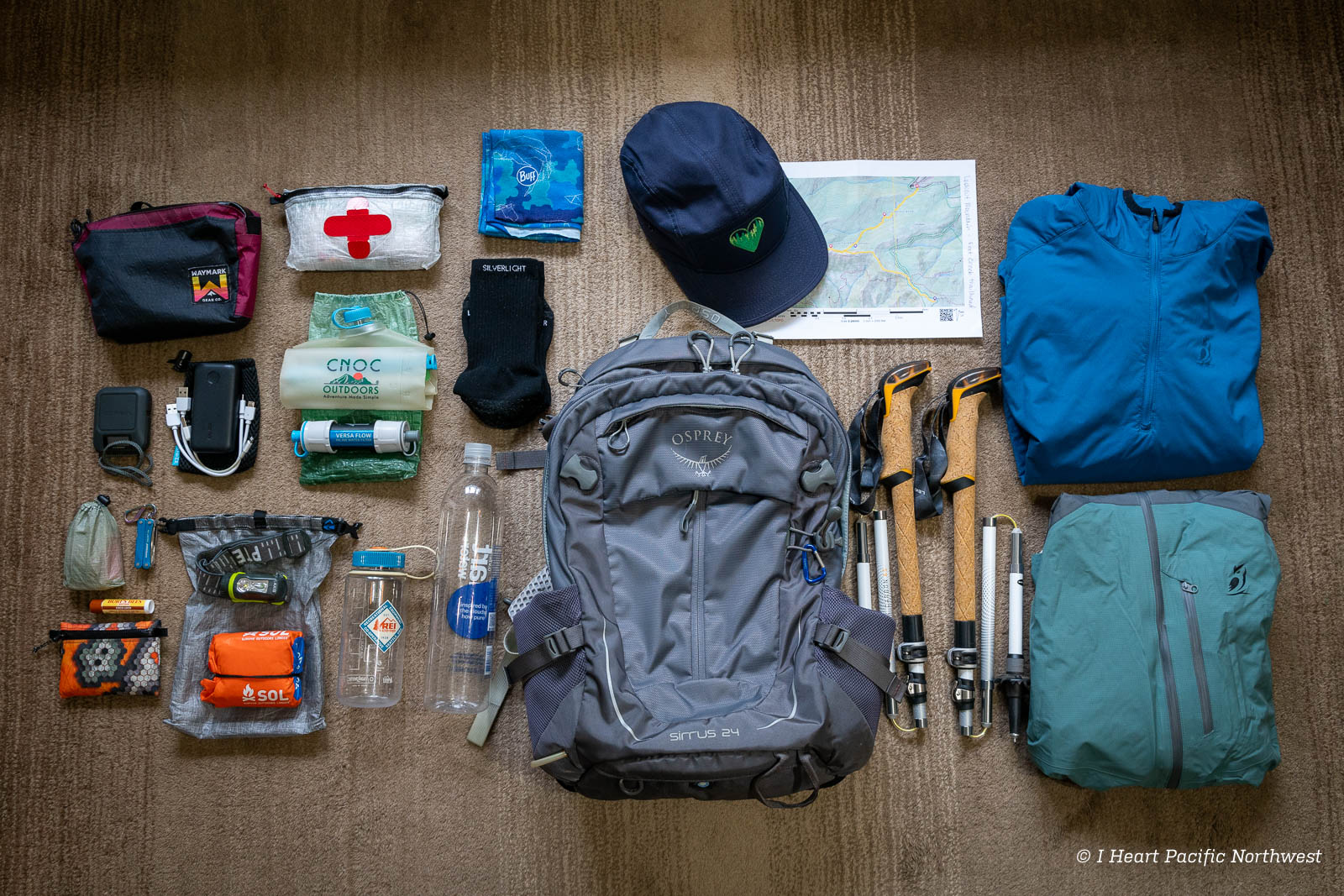
The kit goes in the pack before you choose the hike, not after you decide the hike looks risky. The short, easy outings are where people leave it home, and day hikers are where the rescues are.
On a typical day, I carry all of these items plus a snack, 1-2 meals for my dogs and double the water I think I'll actually need. I have 2 Golden Retrievers so I usually hike with 6 liters of water to keep me and them hydrated no matter what!
FAQs
Do I really need all of this for a short hike?
Yes, but most of it is small and light. Day hikers made up 42 percent of national park rescue cases from 2004 to 2014, and a short loop turns long fast after a rolled ankle, a missed turn, or fading light. The kit costs a few minutes of packing. A night outside without it costs far more.
Is a satellite communicator worth it if my phone has satellite SOS?
Phone satellite SOS is a free backup, but it is slower under trees, and your phone is also your map and light. Apple says messages can take up to several minutes under light or medium foliage. A dedicated communicator like the inReach Mini 3 Plus adds two-way messaging, tracking, and its own battery, at the price of a subscription.
How do I practice satellite SOS on my phone?
On an iPhone 14 or later, open Control Center, tap Cellular, tap Satellite, then tap Try Demo. On a Pixel 9 or later, open Settings, then Safety & emergency, then Satellite SOS, and run the demo. Do it outside with a clear view of the sky. The demos do not contact emergency services, and the Pixel demo turns off your mobile network until you exit.
How far from the trail should I go to the bathroom?
Go at least 200 feet, about 70 steps, from water, trails, parking areas, and campsites. Dig a hole 6 to 8 inches deep and 4 to 6 inches wide, then fill it and cover it with natural material. Pack out used toilet paper and wipes in a double zip bag, and carry a waste bag kit for when digging isn't an option.
Can paracord hold my weight?
No. Nite Ize says its 550 paracord is not designed to hold body weight, lift heavy objects overhead, or serve for climbing and rappelling. Use it for lashing, shelter, and gear repair. Anything that supports a person calls for rated rope and a trained rescue team.
Make sure to check the weather, leave no trace, and have a fantastic hike!